
Everyone living in the world today has royal ancestors who lived somewhere, sometime. Everyone - regardless of race, nationality or personal circumstances. The mathematics of genealogy and demography (below) force this assertion. Thus, there is no exclusivity in claiming royal lineage, but it is fascinating to contemplate documented lines of descent.
Venturing beyond a limited number of generations invites formidable hazards. The possibilities of concealed illegitimacies of birth, unrecorded adoptions, mis-identified paternity and mistaken maternity (particularly among the re-married) are far greater than many of us appreciate, making it difficult to validate genealogical findings conclusively. Moving into the American colonial period, inadequacy of records and conflicting data become increasingly problematical. Pre-17th-century research then confronts further obstacles in the paucity of surnames and the fabrication of illustrious pedigrees.
The likelihood of compound error, arising from mistaking the identity of just one ancestor, is so great that the integrity of any extensive family tree, including this one, can never be regarded as absolute. Accumulating DNA evidence, moreover, may someday disprove even the most carefully documented ancestries.
Within this context, genealogies of royal families and other nobility have been the ones most carefully preserved and scrutinized through the centuries. They have also been the ones most embellished.
Royal genealogies invariably yield a labyrinth of inter-marriages among the crowned heads of Europe as they extend backward in time. Researchers have extended many of our grandparents' ancestral lines well beyond the twelve generations included in this tree, encountering this consanguineous maze that defies intelligible structure.
Royalty aside, no tree can be charted very far historically without somehow exhibiting an increasingly complex network of ancestral repetition, as the result of widespread inter-marriage among distant (and not so distant) cousins. This is inevitable. If a tree should be (impossibly) extended without such duplication beyond 29 generations or so, with ancestors doubling each generation, the people in it would outnumber the estimated population of the world in 1300 AD. By that time, any tree's then-living ancestors would in fact include many of the people resident in the same geographic vicinity.
So, it can be affirmed, for example, that most, if not all, people of European descent share Charlemagne (died 814) as an ancestor, whether or not they have identified their particular line(s) of descent. To emphasize the point, Charlemagne was a descendent of 5th-century Merovingian kings. Some people imagine that those kings were descendents of a married Jesus and Mary Magdalene, who fled pregnant to southern France soon after His crucifixion and resurrection, a tale popularized by the novel 'The DaVinci Code', in which the heroine is portrayed as a modern Merovingian descendent. If this legend were true, millions of us would be descended from Christ, through Charlemagne and other Merovingian offspring.
Ultimately, according to genetic evidence, we are all one family - quite literally. Every one of us is descended from "Mitochondrial Eve" who lived some 150,000 years ago in Africa. As family trees fade into the millennia, they become inter-twined within a tangled forest of ancestral mix:
The Skipwiths, one of the few 17th-century immigrant families to America that is legitimately entitled to a coat of arms, claims a regal ancestry that goes as far back historically as we may permit ourselves to believe.
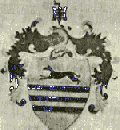
With apologies to those who are strictly serious about genealogical research and may not share a fascination with early European history, two lines of the Skipwith ancestry, pieced together from published materials, are presented below.
The first takes a winding route, through 60 generations of European nobility, back to Roman Emperor Claudius and to Mark Antony, triumvir of Rome.
The second takes a more straight-forward route, through 69 generations of English nobility and royalty, back to the biblical Adam and Eve. Ancestors listed between Alfred the Great and Noah were recorded by the mythological Anglo-Saxon Chronicle, written about 891 AD, within the framework of early Christian interpretation of biblical chronology that placed Adam's birth at 4004 BC, gave 2348 BC as the year of the Great Flood, and gave 1571 BC as the year Moses was born - some notables having lived incredibly long lives.
Both of these lines commence with our tree's 16th century Skipwith couple who lived in Leicestershire, England: Henry Skipwith (died 1588) and Jane Hall (died 1598)
William Skipwith and Alice Dymoke, died 1549, daughter of
Joan Griffith and Lionel Dymoke, died 1519, son of
Thomas Dymoke (died 1470) and Margaret de Welles, daughter of
Joan Waterton and Lionel de Welles, died 1461, son of
Maude de Greystoke and Eudo de Welles, died before 1421, son of
John de Welles (died 1422) and Eleanor de Mowbray, daughter of
Elizabeth Segrave and John de Mowbray, died 1368, son of
John de Mowbray and Joan Plantagenet, died 1349, daughter of
Henry Plantagenet and Maud Chaworth, died 1322, daughter of
Patrick Chaworth and Isabel de Beauchamp, daughter of
Maud Fitzjohn and William de Beauchamp, son of
William de Beauchamp and Isabel Mauduit, daughter of
William Lord Maudit and Alice de Newbery, daughter of
Waleran de Newbery and Margery of Hereford, daughter of
Henry, Earl of Hereford, son of
Humphrey de Bohun and Margaret of Hereford, daughter of
Henry, Prince of Scotland, and Ada de Warrenne, daughter of
William de Warrenne II and Isabel de Vermandois, died 1131, daughter of
Hugh "the Great", Count of Vermandois, and Adelaide, died 1118, daughter of
Adale Hildebrante and Hubert IV, Count of Vermandois, died 1080, son of
Otto, Count of Vermandois (France), died 1045, son of
Emengarde and Hubert III, Count of Vermandois, died 1015, son of
Gerburga and Albert I, Count of Vermandois, died 987, son of
Hildebrante and Hubert (Herbert) II, Count of Vermandois, died 943, son of
Bertha de Morvais and Hubert I, Count of Vermandois, died 902, son of
Pepin II, Count of Vermandois, died 840, son of
Cunigunde and Bernard, King of Lombardy (Italy), died 818, son of
Bertha and Pepin, King of Lombardy, died 810, son of
Hildegarde and CHARLEMAGNE, first Holy Roman Emperor, died 814, son of
Bertha and Pepin III "the Short", King of the Franks, died 768, son of
Bothrude and Charles Martel, King of the Franks, died 741, son of
Alpaida and Pepin II "of Heristal", Duke of Austrasia, died 714, son of
Begga and Ansegisal (Anchises), Markgrave of the Schelde, died 685, son of
Doda and St. Arnolph, Bishop of Metz who died a hermit in 641, son of
Oda and Arnoaldus, Markgrave of the Schelde, died 601, son of
Blithildis and Ausbert, died 570, son of
Deuteria and Ferreolus, Duke of Moselle, son of
Sigimerus I, son of
Basina and Clodius "Long Hair", died 445, son of
Pharamond, Duke, and Argotta, daughter of
Genebald, Duke, died 419, son of
Dagobert, Duke under the Romans, died 389, son of
Clodius V, Frankish king, died 378, son of
Theodomir, Frankish king, died 360, son of
Hastila and Richimir II, Frankish king, died 350, son of
Clodomir IV, Frankish king, died 337, son of
Dagobert, Frankish king, died 317, son of
Walter, Frankish king, died 306, son of
Clodius III, Frankish king, died 298, son of
Batherus, Frankish king, died 272, son of
Hilderic, Frankish king, died 253, son of
Sunno, Frankish king, died 213, son of
Farabert, Frankish king, died 186, son of
Hasilda and Clodomir IV, Frankish king, died 166, son of
Marcomir IV, Frankish king (died 149), and Athildis, daughter of
Coilus "Old King Cole", King of the Britons, died 170, son of
Marius, King of the Britons, died 125, son of
Aviragus, King of the Britons (died 74) and Genissa (Venissa Julia), dau. of
Calpurnia and CLAUDIUS, EMPEROR OF ROME (reigned 42-54 AD), son of
Claudius Drusus Nero Germanicus and Antonia Minor (died 37 AD), daughter of
Octavia Major and MARK ANTONY, Roman triumvir, died with Cleopatra in 31 BC
Ursula Sherington and Francis Hall, Jr., died 1553, son of
Francis Hall, Sr. (died 1534) and Elizabeth Wingfield, daughter of
Elizabeth FitzLewis and John Wingfield, son of
Robert Wingfield (died 1451) and Elizabeth Goushill, daughter of
Robert Goushill and Elizabeth FitzAlan, daughter of
Richard FitzAlan and Elizabeth de Bohun, died 1385, daughter of
Elizabeth de Badlesmere and William de Bohun, died 1360, son of
Humphrey de Bohun and Elizabeth Plantagenet, died 1316, daughter of
Eleanor of Castile and EDWARD I, KING OF ENGLAND (1272-1307), son of
Eleanor of Provence and King Henry III, died 1272, son of
Isabella de Taillefer and King John I, died 1216, son of
Eleanor of Aquitaine and King Henry II, died 1189, son of
Geoffrey V Plantagenet and Empress Maud (Matilda), died 1167, daughter of
King Henry I and Matilda of Scotland, died 1118, daughter of
Malcolm III, King of Scotland and St. Margaret Atheling, died 1093, dau. of
Agatha and Edward Atheling "the Exile", died 1057, son of
Algitha and Edmund II "Ironsides", King of England, died 1016, son of
Aelflaed and Ethelred II "the Unready", King of England, died 1016, son of
Elfrida and Edgar "the Peaceful", King of England, died 975, son of
St. Elgiva and Edmund I, King of England, died 946, son of
Edgina and Edward I "the Elder", King of England, died 924, son of
Alswitha and ALFRED "THE GREAT", King of England, died 901, son of
Ostburga and Ethelwulf, King of England, died 858, son of
Redburge and Egbert, First King of England, died 836, son of
Ealhmund, King of the West Saxons, son of
Eafa, King of the West Saxons, son of
Eoppa, King of the West Saxons, son of
Ingeld, King of the West Saxons, died 718, son of
Cenred, King of the West Saxons, son of
Ceowald, son of
Cutha, son of
Cuthwine, King of the West Saxons, died 584, son of
Caewlin, King of the West Saxons, died 595, son of
Cynric, Kind of the West Saxons, died 560,son of
Cerdic, Saxon invader of England, died 534, son of
Elesa, son of
Esla, son of
Gewis, son of
Wig, son of
Freawine, son of
Frithugar, son of
Brand, son of
Baeldaeg, son of
Woden, "high Saxon god", died 300, son of
Frithwald, son of
Freawine, son of
Frealaf, son of
Frithuwulf, son of
Finn, son of
Godwulf, son of
Geat, son of
Taetwa, son of
Beaw, son of
Sceldwea, son of
Haremod,son of
Itermon, son of
Hrathra, son of
Hwala, son of
Bedwig, son of
Sceaf, "born in the Ark", son of
Noah, son of
Lamech,son of
Mathuselah, son of
Enoch, son of
Jared, son of
Mahalaleal, son of
Cainan, son of
Enos, son of
Seth, son of
ADAM and EVE
We do not know the identities of the first Acrees of our line who arrived in America, much less the identities of ancestors who used some form of our name during the Middle Ages, when surnames first developed. The name is certainly British, but its origin has never been definitively ascertained. Our earliest-known, 18th-century Acree ancestors, living at the time of the American Revolution, spelled their name 'Acre' and regarded themselves as 'Scotch-Irish'. It has been suggested that the name derived in association with the Dacre borderer family, who governed its estates from Naworth Castle in northern Cumbria during the 14th-15th centuries. That family's historic coat of arms, known to heraldry, depicted, on a red background, three silver scallop shells, indicating a pilgrimage to the Holy Land:

In Israel there is an ancient seaport called Acre, known in Roman times as Ptolemais and known afterward as Akko or Accho. It was a notorious stronghold for the European Crusaders who invaded Palestine during the 12th and 13th centuries to bring Jerusalem under Christian control. Some who fought there or were born there returned to England with a D'Acre ('of Acre') appellation, notably 'Joanna de Acre', a child of King Edward I and Eleanor of Castile (listed above).
Eleanor was a daughter of King Ferdinand III of Castile and Leon (Spain), an esteemed yet humble Crusader who was eventually canonized 'San Fernando' for his ascetic piety. In 1254 she wed her English prince as 'La Infanta', a girl of ten. Their marriage evolved into one of royalty's greatest love matches. While they both lived, the two were inseparable and were frequently seen playing chess together. In 1270 Eleanor accompanied her warrior husband on his quest to the Holy Land, where his 'gallant one thousand' came to the rescue of besieged Christian forces holding out behind the walls of Acre. Europe, however, was tired of its Crusades and sent meager reinforcements to maintain Edward's victories. The cruel wars were winding down after nearly two hundred years of suffering on both sides, without lasting accomplishment. The significant interchange of cultures that occurred could only be appreciated centuries later.
After a two-year stay, the couple returned to England with Joanna for their renowned joint coronation. Acre finally fell to the Mamlukes in 1291, ending the Crusades. By the time of her death in her late forties, Eleanor had suffered at least sixteen pregnancies but finally produced a surviving male heir to the throne. Imperious Joanna lived to marry twice but did not give birth to any Acrees.


Copyright © 2001- by Charles Acree. All rights reserved.